Smart 4 Digits Combination Locker Lock Technology for Commercial Applications
As security requirements continue to grow across commercial, educational, industrial, and residential sectors, locker locking systems are evolving rapidly to meet higher standards of convenience, reliability, and user safety. Among the most widely adopted solutions today is the 4 Digits Combination Locker Lock, a compact and highly practical locking mechanism designed to provide secure access without the need for traditional keys.
From schools and fitness centers to offices, warehouses, transportation hubs, and smart storage systems, 4-digit combination locker locks are becoming increasingly popular due to their simplicity, affordability, and operational efficiency. These locks offer users the convenience of password-based security while eliminating many of the problems associated with key management, including lost keys, unauthorized duplication, and expensive maintenance.
Modern combination locker locks are no longer limited to simple mechanical designs. Advances in materials engineering, electronic technology, and industrial manufacturing have enabled the development of durable, tamper-resistant, and intelligent locking systems suitable for a wide range of applications. As organizations seek secure and cost-effective storage solutions, the global demand for combination locker locks continues to expand steadily.
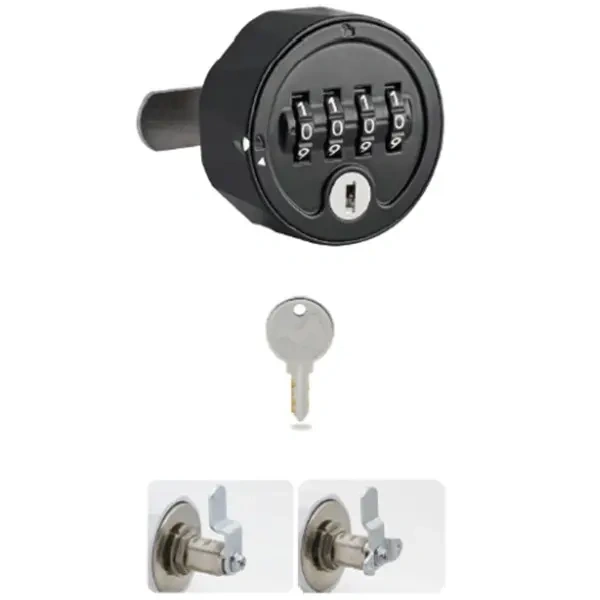
A 4 Digits Combination Locker Lock is a security locking device that uses a four-number code to control access to lockers, cabinets, storage compartments, or personal security enclosures. Instead of relying on physical keys, users unlock the device by entering the correct numerical combination.
The lock typically contains four rotating dials, each displaying numbers from 0 to 9. This configuration provides 10,000 possible code combinations, significantly improving security compared to simpler two-digit or three-digit locking systems.
These locks are commonly available in two primary categories:
- Mechanical combination locker locks
- Electronic combination locker locks
Both types are widely used in environments where multiple users require secure yet convenient access control.
The increasing adoption of keyless locking systems reflects broader trends in modern security management. Traditional keyed locks present several operational challenges:
- Keys can be lost or stolen
- Duplicate keys may create security risks
- Lock replacement costs can be high
- Managing large quantities of keys becomes inefficient
Combination locker locks eliminate many of these issues by replacing physical keys with programmable or manually set numerical codes.
Industries increasingly prefer keyless systems because they improve operational efficiency while reducing administrative burden. In facilities such as gyms, schools, employee changing rooms, and public storage areas, combination locks simplify daily access management for both users and operators.
The operating principle of a 4-digit combination locker lock is based on the alignment of internal components according to a preset numerical code.
Mechanical versions operate through internal cams, gears, or discs connected to external rotating dials. When the correct code is entered, the internal mechanisms align, allowing the locking bolt to retract.
Mechanical models are valued for:
- Long service life
- No battery requirement
- Low maintenance
- High reliability in harsh environments
These locks are commonly installed in schools, industrial facilities, and fitness centers.
Electronic versions use digital keypads or touch interfaces combined with electronic control systems. When the correct code is entered, a small motor or solenoid releases the locking mechanism.
Electronic locker locks often include advanced features such as:
- Temporary user codes
- Master management codes
- Audit tracking
- Automatic locking
- Bluetooth or smart connectivity
These systems are increasingly used in smart lockers and modern commercial facilities.
A four-digit system offers 10,000 potential combinations, providing substantially higher protection than simpler locking systems. Advanced models also include anti-tamper features that resist forced entry attempts.
Some high-security designs incorporate:
- Hardened steel shackles
- Anti-drill protection
- Tamper alarms
- Reset protection mechanisms
These features help improve resistance against unauthorized access.
One of the biggest advantages of combination locks is the elimination of physical keys. Users no longer need to carry keys or worry about losing them.
This provides several operational benefits:
- Reduced lock replacement costs
- Simplified access management
- Faster user turnover
- Improved convenience in public facilities
Keyless operation is especially valuable in environments with frequent user changes.
Combination locker locks help reduce long-term operational expenses. Facilities no longer need to maintain large key inventories or frequently replace lost keys.
Mechanical combination locks are particularly economical because they:
- Require minimal maintenance
- Operate without electricity
- Offer long operational lifespan
This makes them highly cost-effective for large-scale locker installations.
Modern 4-digit locker locks are designed for intuitive use. Large numeric dials, ergonomic designs, and smooth operation improve accessibility for users of all ages.
Electronic models may include:
- LED indicators
- Audible confirmation signals
- Touchscreen interfaces
- Mobile app integration
These enhancements improve overall user experience.
Traditional dial-based locks use rotating wheels or dials to enter the correct combination. These are widely used due to their simplicity and durability.
Applications include:
- School lockers
- Employee lockers
- Gym lockers
- Industrial storage cabinets
Their robust construction makes them suitable for high-frequency usage environments.
Push-button designs use numeric buttons instead of rotating dials. These locks provide quicker code entry and improved convenience.
Advantages include:
- Faster unlocking
- Easy operation
- Compact design
- Reduced mechanical wear
They are increasingly used in modern office furniture and commercial storage systems.
Digital locks incorporate electronic control systems and advanced authentication technologies.
Features may include:
- Programmable passwords
- RFID card compatibility
- Smartphone access
- Remote management
- Usage tracking
Digital locker systems are becoming popular in smart buildings and automated storage facilities.
The durability of locker locks largely depends on material selection and manufacturing quality.
Zinc Alloy
Zinc alloy is commonly used because it provides:
- Good corrosion resistance
- Lightweight construction
- Attractive surface finishing
- Cost-effective manufacturing
It is widely used in indoor locker applications.
Stainless Steel
Stainless steel offers superior corrosion resistance and mechanical strength. It is ideal for:
- Outdoor lockers
- Marine environments
- Industrial facilities
- High-humidity locations
Stainless steel locks provide excellent long-term durability.
Hardened Steel Components
High-security locker locks often use hardened steel for critical components such as:
- Shackles
- Locking bolts
- Internal gears
These materials improve resistance to cutting and forced entry.
Schools and universities are major users of combination locker locks. Students benefit from keyless convenience while administrators reduce key management complexity.
Combination locks are widely installed in:
- Student lockers
- Staff storage cabinets
- Sports facilities
- Dormitories
Their simplicity makes them ideal for large educational environments.
Gym lockers experience heavy daily use, making durability and convenience essential.
Combination locker locks help fitness centers by:
- Eliminating lost key problems
- Improving user experience
- Reducing maintenance costs
- Supporting temporary access use
Many modern gyms now prefer digital combination locking systems.
Factories, warehouses, and corporate offices use locker locks to secure employee belongings and sensitive equipment.
Industrial environments require locks with:
- Strong mechanical durability
- Corrosion resistance
- Reliable long-term performance
Heavy-duty combination locks are commonly used in these settings.
Public storage systems at airports, train stations, and shopping centers increasingly rely on electronic combination locker locks.
Smart locker systems support:
- Temporary rental access
- Mobile payment integration
- Remote monitoring
- Cloud-based management
This sector is expected to see strong future growth.
The locker lock manufacturing industry has evolved significantly with the adoption of precision engineering and automated production technologies.
Computer Numerical Control (CNC) machining enables high-precision production of internal lock components, improving:
- Dimensional accuracy
- Mechanical consistency
- Product reliability
This is essential for high-security applications.
Die casting is widely used for producing zinc alloy lock bodies with excellent surface finish and structural consistency.
Advantages include:
- High production efficiency
- Lower manufacturing costs
- Consistent quality
This process supports mass production for global markets.
Modern locker locks often undergo advanced finishing treatments such as:
- Powder coating
- Electroplating
- Chrome plating
- Anodizing
These treatments improve corrosion resistance and product appearance.
The rise of smart buildings and digital infrastructure is driving the development of intelligent locker systems.
Modern electronic combination locker locks can integrate with:
- Mobile applications
- Cloud management platforms
- Access control systems
- IoT networks
Users can unlock lockers through smartphones, temporary digital credentials, or centralized management software.
This integration improves operational efficiency for commercial facilities and shared storage systems.
As locker technology advances, security threats are also evolving. Manufacturers continue to improve anti-theft performance through enhanced engineering solutions.
Advanced security features may include:
- Anti-pry construction
- Reinforced locking bolts
- Alarm systems
- Wrong-code lockout functions
- Encrypted communication protocols
These technologies help protect users against unauthorized access and theft.
Sustainability is becoming increasingly important in hardware manufacturing industries. Many manufacturers are now adopting environmentally friendly production methods.
Key sustainability initiatives include:
- Recyclable metal materials
- Reduced hazardous coatings
- Energy-efficient manufacturing
- Long-life product design
Durable locker locks reduce replacement frequency, contributing to lower material waste over time.
The global locker lock market is experiencing stable growth driven by expanding urbanization, increasing security awareness, and rising adoption of smart storage systems.
Several major trends are shaping the industry:
Expansion of Smart Lock Technologies
Digital and connected locking systems are becoming mainstream in commercial and public infrastructure.
Increased Demand for Contactless Access
Post-pandemic demand for touchless access systems has accelerated electronic locker lock adoption.
Growth of Shared Storage Services
E-commerce, parcel delivery systems, and public smart lockers are expanding rapidly worldwide.
Rising Investment in Fitness and Education Infrastructure
New schools, universities, and fitness facilities continue to drive demand for durable locker locking solutions.
The future of the industry is expected to focus on higher intelligence, stronger security, and improved user convenience.
Emerging innovations may include:
- Biometric authentication
- AI-based access management
- Wireless energy systems
- Advanced cybersecurity protection
- Fully integrated smart building connectivity
As IoT ecosystems continue expanding, locker locks will likely become part of broader digital facility management systems.
Product quality is critical in the locker lock industry because security performance directly affects user safety and customer trust.
Reliable manufacturers typically offer:
- Strict quality control systems
- Precision engineering capabilities
- Durable material selection
- Compliance with international standards
- Custom OEM and ODM services
Many global buyers now source combination locker locks from specialized manufacturers in China due to competitive pricing and large-scale production capabilities.
The 4 Digits Combination Locker Lock has become an essential security solution across educational, commercial, industrial, and public sectors. Its combination of convenience, affordability, and reliable protection makes it one of the most practical locking systems available today.
As modern facilities increasingly move toward keyless access and smart infrastructure, combination locker locks continue evolving through advanced materials, electronic technologies, and intelligent connectivity features. From traditional mechanical designs to sophisticated digital locker systems, the industry is experiencing rapid innovation driven by rising security demands and expanding smart storage applications.
With growing adoption across gyms, schools, workplaces, transportation hubs, and smart locker networks, the future of 4-digit combination locker locks remains highly promising. Manufacturers that focus on durability, security, and technological advancement will continue to play a vital role in shaping the next generation of secure storage solutions worldwide.